Posts

What to Eat and How to Cook It (1874)
Image
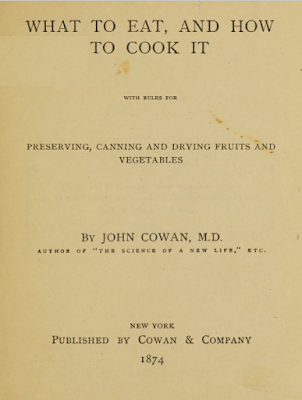
  What to Eat and How to Cook It : With rules for preserving, canning and drying fruits and vegetables   by: John Cowan, MD (1874) https://archive.org/details/whattoeathowtoco00cowa/mode/2up TO LIVE a sweet, healthy life implies the use of simple, nutritious food, cooked in a plain, simple manner, and as nearly in its natural relations as possible. A ripe, mellow apple, and a biscuit made of unbolted wheat meal and water only, represents, when eaten and digested, every constituent required in the nourishing and building up of the body. Pure blood, firm tissue, clear brain, perfect health, and enjoyable life, would—could not help —resulting from the use of such plain, simply prepared food. But the great majority of people do ‘not and will not believe this, else there would not be such a demand for the cooking receipts in fashion, and other magazines, and papers, and cook-books. And such receipts—such conglomerate mixtures —grains, fruits, flesh, grease, spices, minerals, mixed ...

How to Do an Area Study

Image
   Why You Need an Area Study... AND HOW TO DO ONE  (Forward Observer) https://www.youtube.com/watch?v=PkRCqK25ti8 KOCOA: Terrain Analysis for Home Defense https://www.youtube.com/watch?v=KV4zHsYbMZk   SHTF Intelligence Play List (12 videos) https://www.youtube.com/watch?v=ei86otQr9ss&list=PLbVcR4afPYo3QxVRGF3aGK25RmUa76YHx   CA Area Study and Assessment Format (FM 41-10, Appendix B) https://www.globalsecurity.org/military/library/policy/army/fm/41-10/appb.pdf    

Listening Posts: An Intro to SIGINT (S2 Underground)

Image
Listening Posts: An Intro to SIGINT (S2 Underground) https://www.youtube.com/watch?v=Nam87B2u6bo 00:00 - Introduction and History 03:48 - Flight Tracking Apps 06:13 - ADS-B Receivers 07:39 - Software Defined Radios 11:01 - Scanners 15:43 - HackRF Devices 17:35 - Recap 17:58 - Your Own Communications 19:39 - Feasible and Realistic 25:25 - Have a Goal 26:24 - Shelter 29:30 - Automation 30:18 - Integration 31:27 - Closing Thoughts Scanning and monitoring of radio frequencies used by public service agencies (i.e., police and fire departments) can provide advanced warning of potential threats and hazards in an area, as well as providing first-hand information about a developing situation from the responders on scene.   Today most public service agencies, along with other government agencies, and many businesses have transitioned to digital and trunked radio systems. Within the Amateur Radio Service digital modes such as DMR, D-STAR, and C4FM are popular. While analog radio traffic certa...

NATO Phonetic Alphabet, Codes & Signals

Image

Near Vertical Incident Skywave (NVIS)

Image
From OH8STN... Repeaters are down, the Internet is out. Your group has unexpectedly spread beyond Line-of-sight (LOS), and your fallback Rally Points are compromised!  How communications with the entire group will be re-established, is a question that usually goes unanswered! In preparedness, we can often rely too heavily upon VHF and UHF Communications, with lightweight and portable handheld radios. Let’s discuss how to mitigate the potential failure point. If your group communication plan is heavily reliant on VHF and UHF radios, consider a fallback plan using HF NVIS. It will require gear investments, routine training, and the intention to reinforce a traditional VHF UHF Communications strategy. The benefits outweigh the pain! If your group finds itself forced into an unplanned withdrawal, NVIS may be the only way, to safely coordinate a new Rally Point. Remember, without a functioning repeater, the internet, or LOS, that brand new digital radio will at best, become a boat ancho...

Secure (Private) Radio Communications

Image
Many of us use radios for daily (regular) communication. Radios work in remote areas, where there is no cellular service, and provide a back-up means of communication when primary means fail.  But for the most part, the radios we are commonly using - Amateur Radio, CB, FRS/GMRS, MURS - are not in any way secure or private. What we transmit over the air can be heard by whomever might want to listen. However, there are things that we can do to make our radio communication at least a little more private. The following YouTube videos discuss some possible options for more secure (private) radio communications: Secure Comms with Ham Radio ( https://www.youtube.com/watch?v=oIyckKhZrpA )  Secure Radio Communications ( https://www.youtube.com/watch?v=apLxePngNlM )  Ham Radio SHTF Digital Mode for Tactical Comms ( https://www.youtube.com/watch?v=pnr_6gHBjuY ) Secure Voice Communications - Part I ( https://www.youtube.com/watch?v=youElAJGmgM )  Secure Voice Communications - Pa...

Earn Your Amateur Radio Operator Certificate

Image
"In today’s world there is a heavy reliance on centralized communications infrastructure such as cell towers, which are very likely to fail during a disaster. Failure or overload of such infrastructure will cause disruptions in communications and make the disaster response inefficient. Amateur radio does not rely on centralized communications infrastructure, and has the ability to be used to meet the demand during many disaster situations. Thus, it is very important for emergency professionals to understand the value of including amateur radio operators in emergency operations plans." (International Journal of Emergency Services, Vol. 9 No. 2, pp. 109-121, https://doi.org/10.1108/IJES-10-2018-0054) - VA7GUR Amateur Radio in Canada is regulated by a federal government department called Innovation, Science and Economic Development Canada (ISED; formerly Industry Canada).  The first level of authorization is the Amateur Radio Operator Certificate with the Basic Qualification. ...